Internationalization: LPRM undergraduate researcher fellow awarded the Mitacs Globalink Research Award
Johann Jakob Schmitz Bastos, Computer Science student at UFES, has been selected to a three-month research internship at the University of Ottawa, Canada.
🎓 Internationalization · Scientific Research
Johann Jakob Schmitz Bastos, a Computer Science student at UFES and LPRM undergrad research fellow, has been selected for the Mitacs Globalink Research Award and will carry out a three-month research internship at the University of Ottawa, Ontario, Canada, investigating quantum-safe security for federated learning systems.
The student
Johann Jakob Schmitz Bastos is an undergraduate student in Computer Science at the Federal University of Espírito Santo (UFES). His selection for the Mitacs Globalink Research Award is a significant academic achievement, reflecting his commitment to research in computational security and distributed systems.
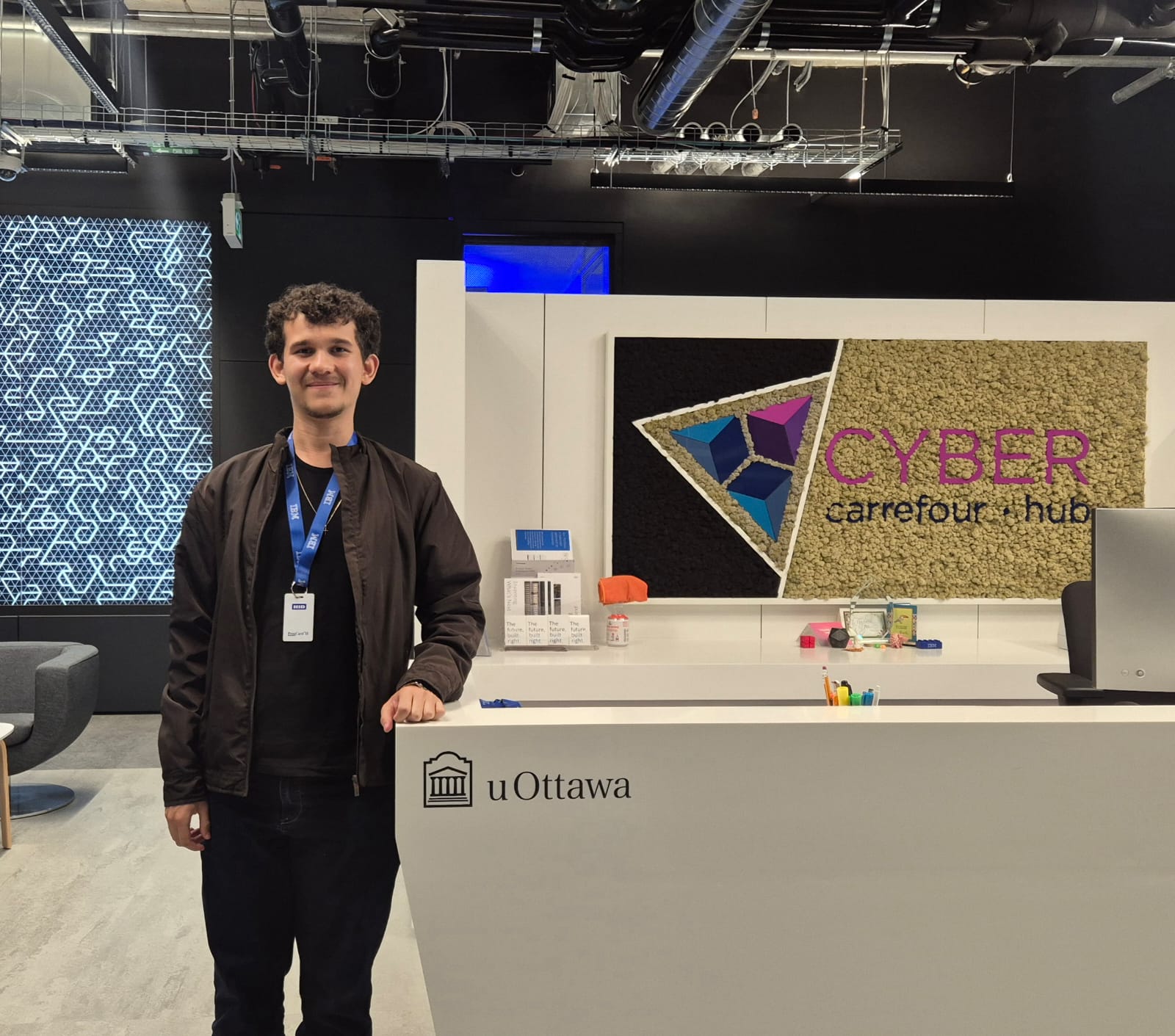
In Brazil, Johann is supervised by Prof. Vinícius Mota (DI/UFES). During his stay in Canada, he will work under the supervision of Prof. Paula Branco at the University of Ottawa in the UOttawa-IBM Cyber Ranger Lab.
What is the Mitacs Globalink Research Award? The Mitacs Globalink Research Award is a highly competitive program that funds international research internships for undergraduate and graduate students, fostering scientific exchange between Brazil and Canada in partnership with CAPES. Selection for this award reflects both the academic excellence of the applicant and the quality of the proposed research project.
The internship and the research
The internship is being carried out at the uOttawa–IBM Cyber Range laboratory, one of Canada’s leading environments for cybersecurity research, from May to July of 2026.
Under the supervision of Prof. Paula Branco, Johann is conducting research in quantum networks, post-quantum cryptography, and federated learning, with a focus on securing distributed AI systems against the threats posed by quantum computing.
The project, titled A multi-layered security strategy for federated learning leveraging distinct quantum-safe technologies, aims to develop and evaluate a quantum-resilient Federated Learning (FL) architecture to ensure long-term security and privacy in distributed machine learning environments.
Federated Learning allows multiple participants to collaboratively train models without sharing raw data. However, current FL systems rely on classical cryptography that remains vulnerable to quantum attacks.
The threat: Harvest Now, Decrypt Later
One of the most pressing risks is the “Harvest Now, Decrypt Later” strategy: adversaries capture and store encrypted communications today, waiting for the moment when sufficiently powerful quantum computers can break the encryption.
“This work aims to establish secure mechanisms for privacy-preserving model training, ensuring that distributed AI systems remain trustworthy and robust in the emerging quantum era.”
Impact and outlook
Johann’s participation in the Mitacs program is more than a personal milestone. It also reflects the strength of the Computer Science bachelor’s course at UFES and the growing international partnerships of LPRM Researcher.
Working at the uOttawa–IBM Cyber Range places the student at the forefront of cybersecurity and quantum computing research, in direct contact with world-class researchers and infrastructure.
The outcomes of this research have the potential to make a meaningful contribution to the global scientific community by addressing one of the most urgent challenges in digital security: preparing AI systems for the post-quantum world.
For more information about the Mitacs Globalink program, visit mitacs.ca/globalink.
For more information about the uOttawa–IBM Cyber Range laboratory, visit the University of Ottawa website.